All-on-4 dental implants typically take between 3 to 6 months from surgery to final teeth. The implant procedure itself is often completed in a single appointment, and many patients leave with temporary fixed teeth on the same day. The full timeline depends on your starting oral health, whether any preparatory treatment is needed, and how your implants heal.
At Radiant Smiles, we guide patients through the full All-on-4 process with detailed planning, digital imaging, and personalised treatment from our Perth team. If you are thinking about replacing failing teeth or loose dentures, book a complimentary dental implant consultation to find out whether All-on-4 is the right treatment path for you.
Key Takeaways
- All-on-4 treatment can often give you fixed temporary teeth on the same day as surgery.
- The full timeline is usually between 3 to 6 months, depending on your healing and treatment needs.
- Some patients may need extractions, bone grafting, or other preparatory work, which can make the process longer.
- The actual implant procedure is often completed in a single appointment.
- Your final permanent bridge is usually fitted after your implants have healed and stabilised.
What are All-on-4 Dental Implants?
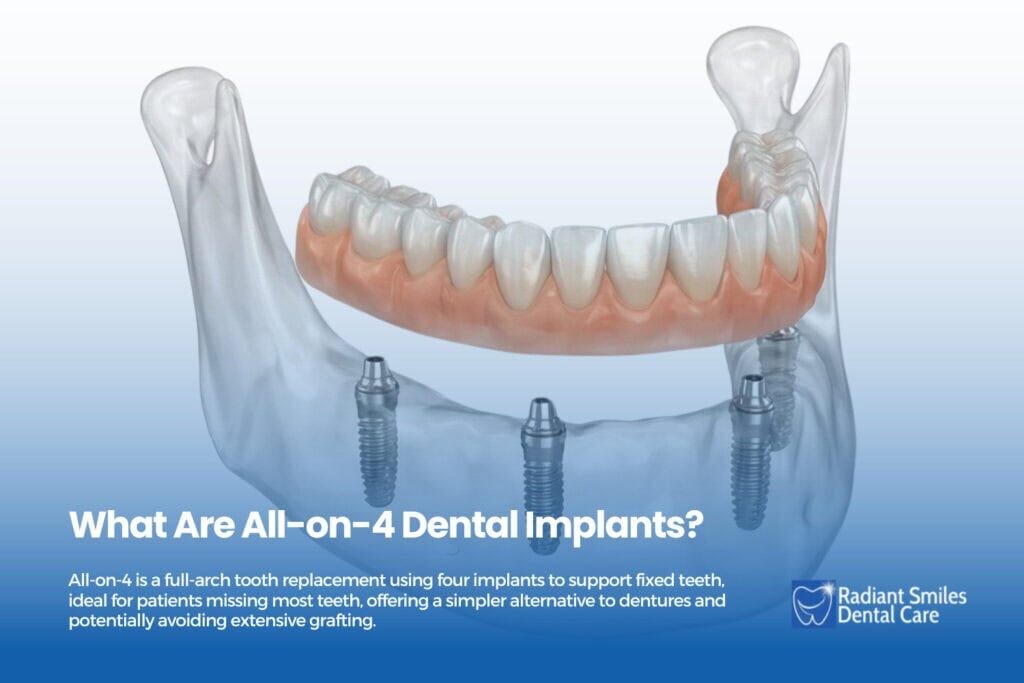
All-on-4 is a full-arch tooth replacement treatment that uses four dental implants to support a complete set of fixed teeth.
This treatment is designed for people who are missing most or all of their teeth in one arch, or who have multiple failing teeth and want an alternative to removable dentures. Instead of replacing each missing tooth with its own implant, All-on-4 uses four strategically placed implants to support a full bridge.
For many patients, this approach can reduce treatment complexity and, in some cases, avoid the need for more extensive grafting procedures.
How is The All-on-4 Treatment Structured?
The timeline varies from patient to patient, but a typical All-on-4 case is often broken down into two parts:
- The treatment day: implants are placed and temporary teeth may be fitted.
- The healing phase: the implants fuse with the jawbone before the final teeth are made.
In many cases, the surgery itself is completed in one appointment, often within a few hours. After that, healing typically takes between 3 to 6 months before the final bridge is fitted.
Therefore, it takes one day to receive temporary fixed teeth, but several months to complete the full treatment.
Understanding the All-on-4 Timeline Step by Step
The All-on-4 process moves through several distinct stages, from your first consultation through to your final bridge. The table below outlines what each stage involves and how long it typically takes.
| Stage | Timeframe | Detail |
|---|---|---|
| Initial consultation and assessment | Week 1 | 3D imaging, oral health review, treatment plan begins |
| Preparatory treatment (if needed) | Weeks to months | Extractions, gum treatment, bone grafting if required |
| Implant surgery | Single appointment | Implants placed, temporary bridge fitted same day in most cases |
| Healing and osseointegration | 3 to 6 months | Implants fuse with the jawbone; the temporary bridge worn throughout |
| Final restoration | After the healing phase is completed and confirmed | Impressions taken, final bridge designed and fitted |
The sections below explain each stage in more detail, including what to expect, what decisions are made, and what can cause the timeline to vary from one patient to the next.
1. Initial consultation and assessment
Your treatment plan starts with a detailed consultation.
At this stage, your teeth, gums, jawbone, bite, and overall oral health are assessed. Your medical history will be reviewed, and you will undergo 3D imaging to understand your bone structure and plan the implant placement accurately.
This appointment determines:
- whether you are suitable for All-on-4 treatment
- whether extractions are needed
- whether bone grafting or other preparatory treatment may be required
- whether your upper, lower, or both arches need treatment
- what your expected timeline is likely to be
2. Treatment planning
Once your assessment is complete, your dentist will create a personalised treatment plan.
This plan maps out the position of the implants, the design of your temporary teeth, the healing period, and the expected timing for your final prosthesis. It also allows for discussions on sedation options, recovery expectations, and any additional procedures that may affect the timeline.
For some patients, treatment can move ahead quickly after planning. For others, more preparation may be needed first.
3. Preparatory treatment, if needed
This is one of the biggest reasons All-on-4 timelines vary.
Some patients can proceed to surgery shortly after their consultation. Others may need preparatory treatment before their implants can be placed, such as:
- removing damaged or infected teeth
- treating gum disease
- bone grafting
- sinus lift procedures in some upper-jaw cases
- allowing extraction sites to heal before surgery
Bone grafting is a procedure where bone material is added to the jaw to build up areas where the bone is too thin or has deteriorated, creating a stable base for the implants. If grafting or staged treatment is required, the timeline may extend by several weeks or months.
How long does the All-on-4 Procedure Take on the Day?
The implant procedure itself is usually completed in a single appointment.
For many patients, treatment day may take between 2 to 4 hours, depending on whether one arch or both arches are being treated and whether extractions are done at the same time.
On the day of surgery, the process usually includes:
- preparing the treatment area
- gently removing any remaining failing teeth if required
- placing the four implants into the jaw
- securing a temporary fixed bridge, if appropriate
This is why many patients hear the phrase ‘same-day teeth.’ You may be able to walk out with a new, fixed smile on the day of your implant surgery.
Same-Day Teeth vs. Final Teeth
This is where many people get confused.
When people hear that All-on-4 can be done in one day, they often assume that the full treatment is complete in one day. But in reality, same-day teeth means you receive a temporary fixed bridge on the day of surgery.
These temporary teeth are designed to:
- restore your appearance quickly
- help you speak and smile with confidence
- protect the implants while healing begins
Your final bridge is made later, after your implants have had time to integrate with your jawbone properly. So, while the visible transformation can happen quickly, the full treatment timeline is longer.
How Long is Recovery After All-on-4 Surgery?
In the first few days after surgery, most patients experience some swelling, tenderness, and discomfort. Rest is recommended, along with soft foods and avoiding strenuous activity. This is normal and manageable with the post-operative instructions and medication provided by your dentist.
Most patients start feeling noticeably better within several days and can return to normal daily activities relatively quickly. During this time your implants are still stabilising beneath the surface, so soft or modified foods are usually recommended for the first few weeks.
Even once you feel well, the implants continue to heal internally. This is why the osseointegration phase - where the implants fuse with the jawbone - takes between 3 to 6 months, regardless of how quickly you feel back to normal.
How long does it Take for All-on-4 Implants to Heal Fully?
The long-term healing stage is called osseointegration.
This is when the implants fuse with the jawbone and become stable enough to support your final bridge. For most patients, this takes between 3 to 6 months.
During this period:
- your implants are integrating with your jawbone
- your dentist monitors your healing
- your temporary bridge remains in place
This healing phase is one of the most important parts of the treatment. Your final prosthesis is planned once healing is complete.
When are the Final Teeth Placed?
Once healing is complete, we move to the final restoration phase.
This usually involves:
- reviewing how your implants have healed
- taking new records or impressions
- checking your bite, smile line, and function
- fitting your final implant-supported bridge
Your final bridge is made to be stronger, more refined, and more durable than the temporary one. This is the stage where your All-on-4 treatment is considered fully complete.
What Factors Affect Treatment Time?
No two implant cases are exactly the same. Several factors can change the treatment timeline:
Bone quantity and quality
Your available bone plays a major role in whether the implants can be placed straight away or whether additional preparation is needed first.
Whether teeth need to be removed
If you have failing or damaged teeth, they may need to be extracted before the treatment.
Need for bone grafting
Some patients may need bone grafting before implant placement, which can extend the timeline.
Gum health
If you have active gum disease or an infection, this may need to be treated first.
General health and healing ability
Medical conditions, medications, and smoking can all influence how quickly and predictably healing occurs.
Upper jaw vs. lower jaw
The upper and lower jaws are different in structure and bone quality, which may affect planning and timing.
One arch or both arches
Some patients only need one full arch restored, while others need both their upper and lower arches treated.
Is All-on-4 Faster than Traditional Full Mouth Implant Treatment?
In many cases, yes.
All-on-4 is often faster and more streamlined than placing individual implants across the full mouth because it uses four strategically placed implants per arch. This simplifies treatment and reduces the need for more extensive surgery.
For suitable patients, that can mean:
- fewer implants
- fewer procedures
- faster restoration of function and appearance
- a quicker path to fixed teeth
How long do All-on-4 Implants Last?
While the timeline to get All-on-4 is important, many patients also want to know how long the result can last.
All-on-4 implants are designed as a long-term solution. With proper care and regular maintenance, the implants themselves can last 20 years or more. The prosthetic bridge on top has a shorter lifespan and may need to be replaced or repaired every 10 to 15 years, depending on the material used, your bite, and how well it is maintained.
Regular dental check-ups and professional cleans are essential to getting the most out of your All-on-4 treatment.
Why Patients Choose Radiant Smiles for All-on-4 in Perth
At Radiant Smiles, we take a personalised approach to full-arch implant treatment. Your timeline is not guessed; it is carefully planned around your oral health, bone structure, and treatment goals.
Our team uses digital imaging and tailored treatment planning to determine a safe and efficient path forward. If you are exploring All-on-4 dental implants in Perth, we can help you understand your options clearly and give you a realistic idea of how long your treatment may take.
Book your complimentary dental implant consultation with Radiant Smiles to discuss your suitability for All-on-4, ask questions about treatment timing, and take the next step towards a fixed new smile.
Disclaimer: Any surgical or invasive procedure carries risks. Before proceeding, seek an opinion from an appropriately qualified health practitioner.
All-on-4 Dental Implants FAQs
Can All-on-4 be done in one day?
The surgical procedure can often be completed in one day, and many patients receive temporary fixed teeth on the same day. However, the full treatment takes several months because the implants need time to heal before the final bridge is fitted.
How long does All-on-4 surgery take?
The treatment day is often completed in one appointment and may take a few hours, depending on the complexity of your case and whether one or both arches are being treated.
How long does it take to recover from All-on-4?
Initial recovery usually takes a few days to a couple of weeks, depending on the patient. Full healing of the implants takes between 3 to 6 months.
Do you get permanent teeth straight away?
No, most patients receive temporary fixed teeth first. The final permanent bridge is fitted after healing is complete.
What if I need bone grafting?
If bone grafting is needed, your timeline may be longer. This is because the grafted area may need time to heal before implant placement can go ahead.
Can I go back to work after All-on-4?
Many patients return to normal daily activities within a few days, but this depends on the nature of your work, your recovery, and whether sedation was used.
Is All-on-4 painful?
The procedure itself is performed with anaesthetic and, where appropriate, sedation options are available. Some discomfort, swelling, and tenderness after surgery are normal, but these are usually manageable during the early healing period.
How do I know if I am suitable for All-on-4?
The best way to know is to have a proper implant assessment. Your dentist will examine your oral health, jawbone, and treatment goals before recommending the right treatment option for you.
Back to Top: How long does it Take to Get All-on-4 Dental Implants?