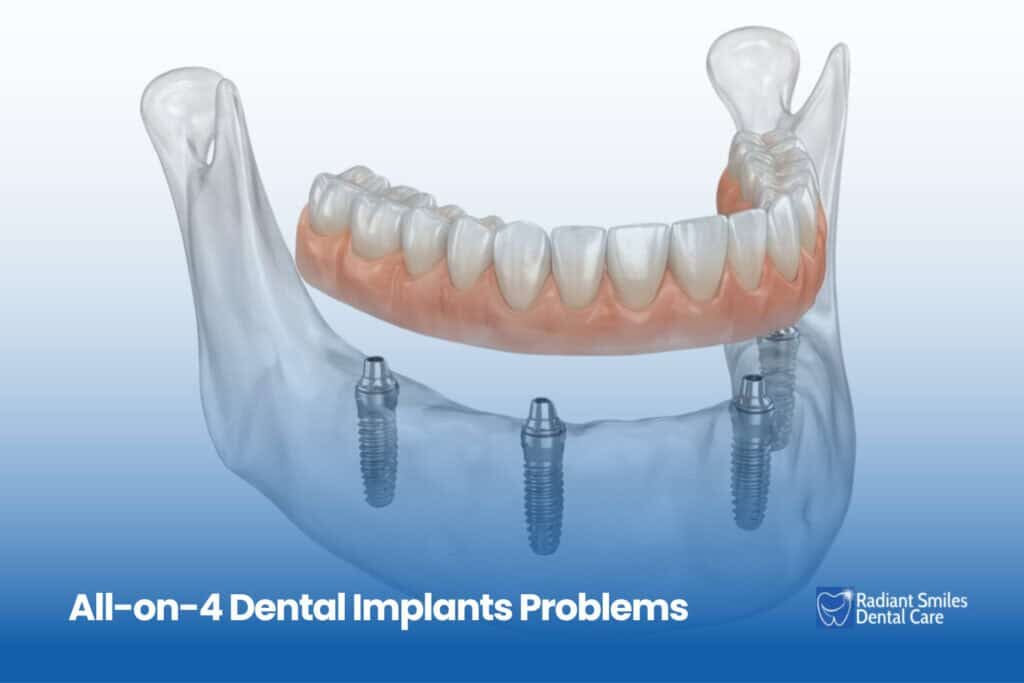
A quick search for All-on-4 turns up a lot of glossy before-and-after photos and not much honest talk about what can go wrong. That is a gap worth filling, because All-on-4 is a major decision that reshapes how you eat, speak, and live for a decade or more. You deserve the full picture before you commit.
This guide walks through the real complications, the regrets we hear in our consult room, and the red flags to watch for when choosing a clinic. It covers what causes each problem, roughly how common it is, and what a careful clinic does to prevent it. This article was written by Dr Anand Ponnusamy, a general dentist at Radiant Smiles, and medically reviewed by our implant dentist Dr Justin Soon, who trained in the All-on-4 technique at the Malo Clinic in Portugal where it was developed. In suitable patients and experienced hands, All-on-4 outcomes are generally very good, with published research reporting implant survival of roughly 95 to 98 percent over ten years. But a good average is not a guarantee for any individual, and the cases that run into trouble tend to share a small set of root causes.
In short: the most commonly reported All-on-4 problems are peri-implantitis (infection around the implants), prosthetic fractures or chips, screw loosening, temporary speech changes, food trapping, and some bone loss over time. Most are manageable or preventable with careful case selection, planning that includes a CBCT scan, quality components, regular hygiene visits, and not smoking. Many of the concerns patients describe are associated with factors such as inadequate planning, unsuitable case selection, limited maintenance, or unmanaged risk factors.
All-on-4 is well established, not experimental
All-on-4 has been used since the late 1990s and was developed and refined at the Malo Clinic in Portugal. It is well studied and, for many patients who have lost most of their teeth or are facing that prospect, it can be a better long-term answer than dentures or staged single-tooth implants.
The risks generally do not come from the technique itself. They tend to come from four places:
- Poor case selection: Not everyone is a candidate, and some clinics take cases they should not.
- Skipped or rushed planning: No CBCT scan, no diagnostic wax-up, no surgical guide.
- Cut-price components: Generic implants, thin prosthetics, and no clear warranty path.
- Patient factors: Heavy smoking, uncontrolled diabetes, or not maintaining the prosthesis.
- Bruxism: Excessive bite forces and teeth grinding (bruxism) can cause failure due to overloading.
Almost every problem below maps back to one or more of those four. It is worth keeping that in mind as you read.
The most common All-on-4 problems and how to reduce the risk
1. Implant failure (the implant does not integrate)
What it is: One or more of the titanium implants fails to fuse with the jawbone and becomes loose or needs removing. Most failures happen in the first three to six months, during the integration phase.
How common: It is important to distinguish implant survival from prosthesis survival. An implant may remain successful while components such as the prosthetic bridge, screws, or acrylic teeth require repair, maintenance, or replacement over time. The risk is higher in people who smoke, as smoking impairs healing and is widely associated with reduced implant success.
What makes it more likely: Insufficient bone, smoking, uncontrolled diabetes, some medications, poor surgical technique, and low-quality components.
What a careful clinic does: Takes a pre-op CBCT scan to assess bone at each implant site; has an honest conversation about smoking and diabetes before booking surgery; uses established, brand-name implant systems with a documented track record; and agrees a clear plan for managing a failed implant before surgery rather than improvising afterwards.
2. Peri-implantitis (infection around the implants)
What it is: Inflammation of the gum and progressive bone loss around an implant, broadly the implant equivalent of advanced gum disease. Left untreated it can lead to implant loss.
How common: Studies commonly report peri-implantitis in around 10 to 15 percent of implant patients at some point. Risk factors include a history of periodontitis, smoking, poor plaque control, uncontrolled diabetes, and irregular maintenance
What makes it more likely: Poor cleaning under the bridge, smoking, a history of gum disease, and skipping professional hygiene visits. We cover candidacy in more detail on our page about All-on-4 with gum disease. The shape of a full-arch bridge makes home cleaning harder than cleaning natural teeth, so professional support matters more, not less.
What a careful clinic does: Designs the prosthesis with cleanable contours from the start; teaches the right cleaning tools and routine at handover; schedules regular six-monthly check-ups; and uses periodic radiographs to catch early bone changes before they become serious.
3. Prosthetic bridge fracture or chipping
What it is: The visible teeth portion that sits on the implants chips, cracks, or fractures. Acrylic prosthetics are the most common to chip.
How common: Materials have different typical lifespans before they need repair or replacement: acrylic is often cited at around 5 to 10 years, zirconia longer. Within any of those windows, chips can happen, especially on front teeth from hard foods or grinding.
What makes it more likely: A thin or under-engineered bridge, no nightguard for people who clench, biting hard foods such as nuts, ice, or hard crusty bread, and choosing the prosthesis on price alone.
What a careful clinic does: Explains the lifespan trade-offs of each material honestly upfront, reinforces acrylic prosthetics with a metal framework to spread bite forces, provides a nightguard for patients who show signs of clenching, and repairs minor chips rather than defaulting to a full remake.
4. Loose or broken prosthetic screws
What it is: The small screws fixing the bridge to the implants can loosen over time or, less often, fracture. A loose screw can make the bridge feel wobbly when chewing.
How common: Screw loosening is one of the more common mechanical issues over the life of the prosthesis. Screw fracture is less common but more involved, as a broken screw inside the implant needs careful removal.
What makes it more likely: A bridge that does not sit perfectly flush against the implants, incorrect tightening at delivery, heavy biting forces, and skipped follow-ups where early loosening could have been caught.
What a careful clinic does: Uses a well-fitting framework from a quality lab, tightens every screw to the manufacturer’s specification with a calibrated torque wrench, checks the screws and bite at each maintenance visit, and keeps the matching components on hand so a loose screw is a quick fix.
5. Speech changes (the temporary lisp)
What it is: Many patients report a temporary lisp or a thick-tongue feeling for the first few weeks after the bridge is fitted, particularly with upper-arch cases, as the tongue adjusts to new tooth positions.
How common: Some speech adjustment is common early on. Speech problems lasting beyond a few months are less common and usually point to a bridge design that needs adjusting, such as a palate that is too thick or front teeth positioned slightly wrong.
What makes it more likely: Skipping the trial stage and going straight from extraction to a fixed bridge without testing tooth position first.
What a careful clinic does: Uses provisional restorations where appropriate to assess tooth position, aesthetics, speech, and function before the final prosthesis is fabricated, designs an upper bridge with a low-profile palate to reduce both the lisp and the gag reflex, and schedules a speech check after fitting so small adjustments can be made.
6. Food trapping under the bridge
What it is: Food, especially seeds, salad leaves, and stringy meat, can get caught between the bridge and the gum and need a water flosser or super-floss to clear. It is one of the most common day-to-day annoyances patients describe.
How common: Common to some degree. The prosthesis sits slightly above the gum to allow cleaning access, so a small gap exists by design. Whether it is a minor habit or a constant irritation depends on the bridge design and the cleaning routine.
What makes it more likely: A bridge with too much space underneath, or one fitted too tightly against the gum, plus skipping the daily cleaning routine.
What a careful clinic does: Designs a smooth fit surface that flushes clean with a water flosser, demonstrates a clear cleaning routine (see our guide on how to clean All-on-4), and reviews and reshapes the fit surface at maintenance visits if trapping gets worse.
7. Nerve disturbance (lower-arch cases)
What it is: A major nerve runs through the lower jaw. If a lower implant is placed too close to it, a patient can experience numbness or tingling in the lower lip and chin, which in rare cases can be lasting.
How common: Uncommon in experienced hands, but it is one of the more consequential surgical complications when it does happen, which is why prevention matters so much.
What makes it more likely: Planning from a 2D x-ray alone without 3D imaging, aggressive implant placement, and no surgical guide to control drill depth and angle.
What a careful clinic does: Plans every lower-arch case from a CBCT 3D scan that shows the nerve path, keeps a safe margin away from the nerve canal, uses guided or angled placement to control depth, and has a clear plan for the rare cases where post-op tingling develops, since early review improves the odds of recovery.
8. Sinus complications (upper-arch cases)
What it is: The upper jaw sits below the sinuses. An upper implant placed into too little bone can affect the sinus floor and contribute to sinus problems or implant failure.
How common: Uncommon when planned properly. It is more of a risk where clinics push standard implants into inadequate bone instead of planning an alternative.
What makes it more likely: Severe upper-jaw bone loss with no grafting or alternative plan, over-long implant selection, and not using a CBCT to assess the sinus floor.
What a careful clinic does: Assesses the sinus floor and remaining bone on the pre-op CBCT, offers appropriate alternatives such as bone grafting or angled tilted implants where suitable, and refers complex cases when additional expertise or multidisciplinary management would benefit the patient.
9. Bite issues and jaw discomfort
What it is: A new full-arch bridge changes how your teeth meet. If the bite is not balanced carefully, the jaw joint and chewing muscles can become sore.
How common: Minor bite adjustments are needed in most cases. Significant jaw problems are uncommon when the bite is checked properly, but they are a real issue when they are missed.
What makes it more likely: Rushing the delivery appointment, not checking how the teeth meet across all chewing motions, and not following up to refine the bite.
What a careful clinic does: Checks and adjusts the bite at delivery, books follow-up visits specifically to refine it as the muscles settle, and provides a nightguard for patients who clench, which protects both the bridge and the jaw.
10. Bone loss over time
What it is: A small amount of bone change around implants in the first year is considered normal. Beyond that, ongoing bone loss can show as the gum receding around the implants.
How common: A small amount of early bone change is common. Significant ongoing loss is less common and usually points back to peri-implantitis, heavy bite forces, or smoking.
What makes it more likely: The same things that cause peri-implantitis, plus excessive bite force and a poorly fitting bridge that loads the implants unevenly.
What a careful clinic does: Takes a baseline radiograph when the final bridge is fitted and compares it over time, treats early peri-implantitis before bone loss becomes harder to reverse, and adjusts the bite or replaces a failing component before it affects the underlying bone.
Questions to ask before choosing a clinic
Any clinic worth your money will answer these clearly:
- Who is the surgeon, and what is their implant training and experience? Look for named credentials, not a generic reference to the team.
- Is a CBCT scan part of the planning, and is it included in the price?
- What implant system do you use, and is it an established, recognised brand with an available parts and warranty path?
- What are the written warranty and aftercare terms, and what conditions apply?
- Where is the prosthesis made? A local lab makes communication and remakes easier.
- What is the follow-up schedule, and is it included in the quoted cost?
- How many All-on-4 cases has the surgeon completed?
If a clinic gives you a single-page quote with no itemisation, no named surgeon, no written warranty, and pressure to decide on the spot, take that as a reason to slow down and get a second opinion.
Frequently asked questions
What are the long-term problems with All-on-4 dental implants?
The issues most often discussed long-term are peri-implantitis, wear or fracture of the prosthetic teeth (especially with acrylic), some bone loss if hygiene lapses, and occasional screw loosening. These are generally manageable with regular professional maintenance and a good home-care routine. Implant failure after the first year is less common in suitable patients.
What can go wrong with All-on-4 dental implants?
The clinical problems that can occur include implant failure (most likely in the first few months), peri-implantitis, prosthetic fracture or chipping, screw loosening, bite imbalance, food trapping, temporary speech changes, and less commonly nerve disturbance or sinus issues. Many are reduced with proper planning, quality components, regular maintenance, and not smoking.
What is the failure rate of All-on-4 implants?
Published research reports implant survival of around 95 to 98 percent over ten years in suitable candidates. Failure is more likely in people who smoke, have uncontrolled diabetes, or skip maintenance, and most failures occur in the first three to six months. These are population averages and not a guarantee for any individual case.
Why do some dentists not recommend All-on-4 for everyone?
Some dentists prefer alternatives such as individual implants or designs using more than four implants for certain patients, and some are cautious about All-on-4 in people with active gum disease, heavy smokers, or conditions affecting healing. The technique itself is well evidenced; the real question is whether each individual patient is a good candidate.
Can All-on-4 implants be removed if there are problems?
Yes, though it is not a simple procedure. Removing a failed implant typically involves unscrewing or carefully cutting it out, after which the bone needs time to heal before a replacement can be placed. This is one reason established, brand-name systems matter, because replacement components are available and documented.
How soon can problems appear?
Issues tend to appear in one of two windows: the first six months (integration failure or early infection) or later in the prosthesis lifespan (wear, or peri-implantitis where maintenance has lapsed). The years in between are usually uneventful when the case was planned well and the patient attends regular check-ups.
Are there alternatives to All-on-4?
Yes. Alternatives include designs using more than four implants, implant-supported overdentures that are removable and easier to clean, full-mouth individual implants, or conventional dentures. The right choice depends on your bone, your budget, and how you want to live day to day. A good consult should walk you through the options rather than sell you one.
Is All-on-4 worth it?
For many patients with failing teeth or long-standing denture problems, the quality-of-life improvement and the published survival data make it a strong option. Whether it is right for you depends on your candidacy, your willingness to maintain it, the clinic you choose, and having realistic expectations about both the result and the upkeep.
What to do next
If you have read this far, you are already doing the homework that helps reduce your risk. The most useful next step is a proper consult that includes a CBCT scan, an itemised quote, a named surgeon, and written warranty and aftercare terms, before you make any commitment.
At Radiant Smiles we offer an initial consultation that includes 3D imaging and an honest assessment of whether All-on-4 is the right answer for you. You can book a consultation at our Yokine or Albany clinic. For the full picture on the procedure, the cost, and the surgical day, start with our main All-on-4 implants in Perth page.
Important: Any surgical or invasive procedure carries risks. Before proceeding, you should seek a second opinion from an appropriately qualified health practitioner. The information on this page is general in nature and does not replace personalised advice from your treating dental practitioner. Individual results vary, and the statistics quoted are population averages drawn from published research, not a guarantee of outcome in any individual case.
Written by Dr Anand Ponnusamy, Bachelor of Dental Science (Annamalai University, 2008), Master of Dental Public and Primary Health (University of Western Australia, 2012). Member of the Royal Australasian College of Dental Surgeons. Around ten years’ experience in private-sector dentistry, with clinical interests in implant dentistry, orthodontics, complex dental treatment, laser dentistry, and cosmetic treatment.